
Ethereum / Complete guide
Ethereum (ETH): The Complete Guide to Smart Contracts, Staking, DeFi and Web3
Ethereum is a programmable blockchain supporting decentralized finance, stablecoins, NFTs, tokenization, gaming, and Web3 applications. This guide explains how Ethereum and ETH work—and the risks every user should understand.

In this guide
At the center of Ethereum is Ether (ETH), the native asset used to pay fees, secure the network through staking, interact with applications, and transfer value.
Since launch, Ethereum has evolved into a large ecosystem supporting DeFi, NFTs, stablecoins, decentralized applications, tokenization, gaming, infrastructure, and many other Web3 technologies.
What Is Ethereum?
Ethereum is a decentralized blockchain network that allows developers to build and operate applications without relying entirely on a centralized company or intermediary.
Unlike a blockchain designed primarily to transfer digital currency, Ethereum is programmable. Developers can deploy smart contracts—programs stored and executed on the blockchain according to predefined rules.
- A blockchain network
- A programmable platform
- An ecosystem for decentralized applications
- A settlement layer for digital assets
- A foundation for many Web3 projects
What Is ETH?
ETH, or Ether, is Ethereum’s native digital asset. It has several important functions within the network.
Transaction fees
Pay gas when sending ETH, swapping tokens, minting NFTs, or using applications.
Network security
Stake ETH directly or through a service to participate in Proof of Stake.
Digital asset
Hold and transfer ETH using exchanges, custodians, or compatible wallets.
Web3 utility
Use ETH throughout a broad ecosystem of applications and digital assets.
How Does Ethereum Work?
Ethereum operates through a decentralized network of computers called nodes. These nodes maintain and verify the blockchain according to the protocol’s rules.
When a user submits a transaction, it propagates through the network. Validators participate in processing and confirming it. Once accepted, the transaction becomes part of Ethereum’s blockchain history.
Create
A wallet signs an operation
Broadcast
The transaction reaches nodes
Validate
The network checks the rules
Include
A validator proposes a block
Finalize
The record joins blockchain history
Ethereum and Smart Contracts
A smart contract is a computer program deployed on a blockchain that can automatically execute predefined instructions. In simple terms: if condition A occurs, execute action B.
Smart contracts support decentralized exchanges, lending, borrowing, NFT marketplaces, token issuance, DAOs, games, stablecoins, automated financial products, identities, and tokenized assets.

What Are Ethereum Gas Fees?
Gas measures the computational work required to execute an operation. Users pay gas fees in ETH for the resources their transactions consume.
ETH transfer
Generally requires a relatively simple operation.
Token swap
A decentralized exchange interaction needs more computation.
Complex contract
Multi-step operations can consume significantly more resources.
Fees change with network demand. When activity rises, users may experience higher costs.
Ethereum’s Proof-of-Stake System
Ethereum transitioned from Proof of Work to Proof of Stake in September 2022 through an upgrade commonly known as The Merge.
Validators secure the network by staking ETH, participating in consensus, and helping maintain blockchain integrity. This transition significantly reduced Ethereum’s energy consumption compared with its former Proof-of-Work system.
What Is Ethereum Staking?
Staking involves committing ETH to participate in Ethereum’s consensus mechanism. A validator may receive rewards for performing its responsibilities correctly, but staking is not a guaranteed-interest savings account.
- ETH price volatility
- Validator penalties
- Smart-contract risk through third-party services
- Liquidity limitations
- Platform or provider risk
- Technical risk
- Changing reward rates
| Approach | Potential benefit | Important consideration |
|---|---|---|
| Holding ETH | Exposure to ETH price movements | No validator operation; market risk remains |
| Staking ETH | Potential staking rewards | Adds technical, provider, and liquidity considerations |
Ethereum and Decentralized Finance
Ethereum is one of the foundational networks for decentralized finance. DeFi protocols use smart contracts to provide services such as exchanges, lending, borrowing, liquidity provision, derivatives, stablecoins, asset management, and automated market-making.
Ethereum and Stablecoins
Ethereum is a major ecosystem for stablecoins—digital assets designed to maintain a relatively stable value against a reference asset, often a fiat currency such as the US dollar.
- Payments and remittances
- Trading and settlement
- DeFi activity
- Digital asset transfers
Risk depends on the issuer, reserves, redemption mechanism, smart contracts, regulatory environment, and overall structure.
Ethereum and NFTs
Ethereum played a major role in the growth of non-fungible tokens. NFTs can represent unique digital assets or ownership records for art, collectibles, games, memberships, tickets, identities, virtual items, and brand experiences.
Owning an NFT does not automatically transfer copyright or intellectual-property rights. Those rights depend on the creator’s or project’s terms.
Ethereum Layer-2 Networks
Layer-2 networks process transactions using infrastructure built on top of Ethereum while relying on Ethereum for important security or settlement functions, depending on their architecture.
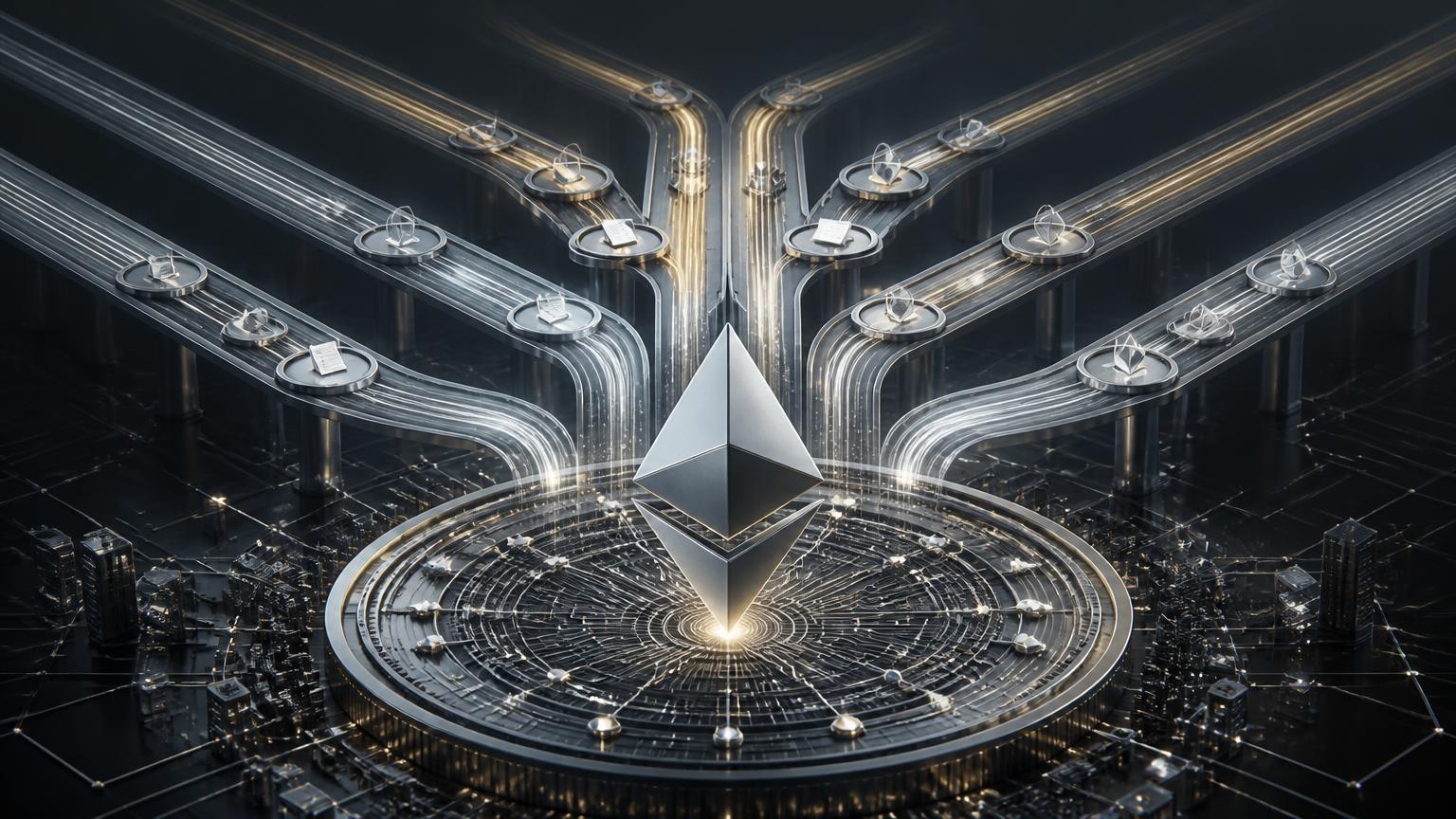
- Higher transaction throughput
- Lower transaction costs
- Improved application scalability
- A smoother user experience
Ethereum Wallets, Private Keys and Seed Phrases
An Ethereum wallet lets users manage keys and interact with Ethereum-compatible applications. Software wallets emphasize access, hardware wallets isolate keys on dedicated devices, and exchange wallets place custody with a provider.
Software wallet
A phone, desktop, or browser application for managing keys and applications.
Hardware wallet
A dedicated physical device often used for additional long-term protection.
Exchange wallet
Convenient custody where the provider, rather than the user, controls the keys.
Ethereum Transactions
An Ethereum transaction can contain a sender address, recipient address, amount, fee details, nonce, and smart-contract data. Each receives a unique transaction hash that can be inspected through a blockchain explorer.
Sending assets to the wrong address or an incompatible network can result in permanent loss. Always verify the destination and selected network before confirming.
Ethereum Token Standards
Ethereum introduced standards that help developers create compatible digital assets. ERC-20 is commonly used for fungible tokens, while ERC-721 became strongly associated with NFTs.
Standardized interfaces let wallets, exchanges, and applications interact with many assets in consistent ways, supporting Ethereum’s broad developer ecosystem.
Ethereum Supply, Issuance and Fee Burning
ETH does not have Bitcoin’s simple fixed maximum. Its supply is shaped by issuance, validator rewards, network activity, burned ETH, and protocol changes.
EIP-1559 fee burning
A base portion of transaction fees is burned, removing ETH from circulation. Higher network demand can increase the amount burned.
Depending on issuance and activity, overall supply can increase or decrease over a period. Investors should not assume ETH is permanently deflationary.
Ethereum Compared With Bitcoin
Bitcoin and Ethereum are major blockchain networks designed around different approaches and use cases. One is not universally better than the other.
| Feature | Bitcoin | Ethereum |
|---|---|---|
| Primary role | Digital monetary network | Programmable blockchain ecosystem |
| Native asset | BTC | ETH |
| Consensus | Proof of Work | Proof of Stake |
| Smart contracts | More limited scripting | Extensive smart-contract platform |
| Applications | Primarily monetary and payment-related | DeFi, NFTs, dApps, tokens, stablecoins and more |
| Supply model | Maximum supply of 21 million BTC | Dynamic ETH supply shaped by issuance and burning |
| Developer ecosystem | Strong | Very extensive |
Ethereum Investment Considerations and Major Risks
ETH is a highly volatile asset. Its price can respond to market sentiment, network activity, DeFi adoption, institutional demand, regulation, competition, upgrades, macroeconomic conditions, Bitcoin movements, and liquidity.
A strong ecosystem does not guarantee ETH’s price will increase, and a short-term price decline does not necessarily mean the technology has failed.
Market volatility
ETH can experience significant price movements within short periods.
Smart-contract risk
Applications can contain coding errors, design weaknesses, or vulnerabilities.
Phishing and scams
Fake websites, wallets, messages, and investment offers target crypto users.
Private-key loss
Losing recovery credentials can permanently remove access to assets.
Regulatory risk
Cryptocurrency laws differ between countries and can change over time.
Infrastructure risk
Wallets, exchanges, bridges, and service providers can fail or be attacked.
Third-party risk
Custodians, staking providers, and DeFi platforms add counterparty exposure.
How to Buy and Store Ethereum Safely
Choose a reputable platform
Use a cryptocurrency service that is permitted and available in your jurisdiction.
Complete required verification
Identity checks may be required depending on the service and local rules.
Deposit funds
Add funds using one of the provider’s available payment methods.
Purchase ETH
Select ETH, review the price and fees, and enter the amount you intend to purchase.
Secure your ETH
Use suitable custody or a wallet you control, and always verify the supported network.
Long-term security practices
- Use strong, unique passwords
- Enable two-factor authentication
- Keep recovery phrases offline
- Check URLs and wallet prompts carefully
- Avoid signing unfamiliar transactions
- Review smart-contract permissions
- Keep wallet software updated
- Consider separate wallets for different purposes
No single storage method is perfect for every user. Match custody decisions to your knowledge, needs, and risk tolerance.
Institutional Adoption and Real-World Asset Tokenization
Institutions, developers, financial companies, and technology businesses have explored Ethereum for custody, stablecoins, settlement, investment products, financial infrastructure, and tokenization.
Tokenization creates blockchain-based representations of assets or financial claims, potentially supporting faster settlement, programmability, transparency, fractionalization, automated compliance, and global digital infrastructure.
- Bonds and investment funds
- Real estate interests
- Commodities
- Other financial instruments
Ethereum’s Developer Ecosystem and Upgrades
Ethereum has one of the world’s largest blockchain developer ecosystems. Developers use smart-contract languages such as Solidity alongside frameworks, wallets, block explorers, exchanges, oracles, infrastructure providers, Layer-2 systems, and security tools.
The roadmap continues to focus on scalability, transaction efficiency, network capacity, validator experience, data availability, usability, and security.
Development is not controlled by a single traditional company. Changes emerge through a decentralized process involving researchers, developers, validators, application teams, and the wider community.
What Could Ethereum’s Future Look Like?
Ethereum’s future will depend on adoption, technology, competition, regulation, and developer activity.
Scaling
Layer-2 and other technologies may support substantially more activity.
Stablecoins
Blockchain payments and settlement may remain an important use case.
Tokenization
Traditional assets may increasingly use blockchain-based infrastructure.
Consumer applications
Wallets and account abstraction could make applications easier to access.
Ethereum remains significant because of its smart contracts, developer adoption, DeFi, stablecoins, token standards, NFT infrastructure, Layer-2 ecosystem, institutional experimentation, and large application network.
It also faces substantial competition. Long-term relevance will depend on continued progress in scalability, usability, security, and decentralization.
The ecosystem in one view
Ethereum at a Glance
Frequently Asked Questions About Ethereum
Final Thoughts
Ethereum has grown far beyond its original concept of a programmable blockchain. It now supports a broad digital economy involving DeFi, stablecoins, NFTs, tokenized assets, decentralized applications, Layer-2 networks, and other Web3 technologies.
ETH is central to this ecosystem through fees, staking, transfers, and application interactions. Yet Ethereum is not a risk-free investment or technology: markets are volatile, smart contracts can fail, scams are common, regulation evolves, and security mistakes can permanently lose funds.
Ethereum’s most important long-term question is not simply how high ETH’s price can go, but how effectively the network can continue developing useful, secure, scalable, and accessible infrastructure for the global digital economy.
Continue Building Your Crypto Knowledge
Compare Ethereum’s programmable ecosystem with Bitcoin’s decentralized monetary network.
Read the Bitcoin guide